What You Can Actually Eat on a Caimito (and What to Leave Alone)
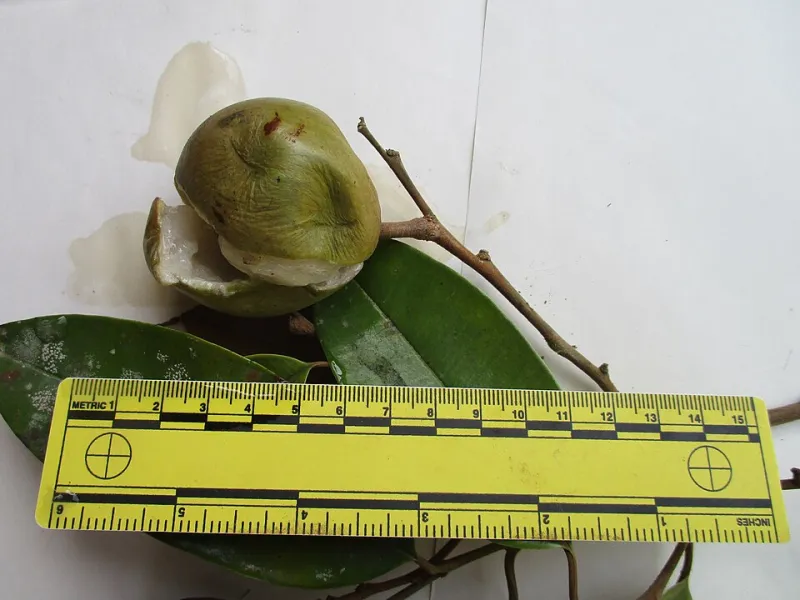
Photo: David E Mead, CC0, via Wikimedia Commons
Star apple has a way of making people nervous. It's round, it's purple or green, it's full of milky sap, and it doesn't look much like anything in the American produce aisle. So the questions tend to pile up: do you eat the skin? What about the seeds? Why is it bleeding white stuff onto my cutting board?
Let's clear it up. The short version: there's exactly one part of a caimito you're after, and it's the soft, translucent pulp inside. Everything else is packaging, hardware, or a mess waiting to happen.
The only part you're really after
The edible portion is the flesh — a creamy, jelly-like layer that surrounds the seeds and lines the inside of the skin. Depending on the variety it ranges from pale white to a violet so deep it looks like it's been dyed. It tastes mild and sweet, somewhere in the neighborhood of a lychee crossed with a very ripe pear, with a texture that's almost custard.
The best way in is the one your grandmother probably used: cut the fruit in half around its equator, not through the stem end. You get two shallow cups, and a spoon does the rest. Slicing through the poles is a mistake — it drags the knife through the seed cavity and smears latex into the part you wanted to eat.
The skin: technically edible, practically not worth it
The skin is the question everyone asks, and the honest answer is that eating it is not the custom anywhere star apple is a real food. It's thick, leathery, and loaded with the same latex that makes the fruit sticky. Bite into it and you get a chalky, astringent, gluey sensation that overwhelms the delicate pulp underneath.
Some people do use the rind as a serving vessel — halve it, scoop the pulp, chop it with lime and a little sugar, and spoon it back into the shell. That's a good trick. The shell itself is a bowl, not an ingredient.
The seeds: leave them
A star apple holds anywhere from three to ten flat, glossy, dark seeds. They're hard, they're bitter, and they're not something to snack on. Spit them out or fish them out before you blend, freeze, or cook the pulp.
That matters more than it sounds. If you're making a smoothie or a syrup, strain the pulp or pick the seeds out first — a high-speed blender will happily turn a seed into grit, and you'll taste it.
The sap: the part that fights back
Cut a star apple and you'll see it: a white, milky latex that beads up along the knife and clings to your fingers. It's the fruit's defense mechanism, and it's the number one reason people describe their first caimito experience as 'sticky.'
The good news is that ripe fruit carries far less of it than unripe fruit. The bad news is that even a ripe one will leave a film on your hands and your board.
A few practical notes:
- Wipe, don't rinse. A dry paper towel gets most of the latex off your knife and board faster than water does. Water tends to spread it around.
- Oil helps on skin. A little cooking oil on your hands, worked in and then washed off with soap, breaks the stickiness down quicker than soap alone.
- Work on a plate, not a cutting board. Fewer surfaces to clean.
- Skip the fruit if the sap is still flowing freely. Heavily sapping fruit usually means it's underripe.
Ripeness is the whole ballgame
Most complaints about caimito — the gummy texture, the astringent aftertaste, the glue factor — trace back to eating one that wasn't ready. A ripe star apple gives slightly when you press it with a thumb, the skin has gone fully colored and lost its green shoulders, and the stem end smells faintly sweet. Underripe fruit is firm, sappy, and unpleasant no matter how you prepare it.
If you buy fruit that's a day or two out, leave it on the counter — not in the fridge, which stalls ripening and dulls the flavor. Once it's soft, eat it within a couple of days. Star apple does not wait around.
Common mistakes worth avoiding
- Slicing pole to pole. It drives latex into the flesh and crushes the seed cavity.
- Scooping too deep. Stop before you scrape the inside of the rind; the last layer against the skin is where the astringency hides.
- Blending skin and seeds into a smoothie. You'll get a bitter, gritty drink.
- Chilling before ripening. Cold fruit ripens poorly and unevenly.
- Judging by color alone. Purple and green varieties both exist, and both ripen on their own schedules.
What to ask before you buy
At a specialty market, a Caribbean grocery, or a farmers market in South Florida, a couple of quick questions will save you a bad purchase:
- When did these come in? Star apple has a short window after arrival.
- Are they ripe now, or do they need a day or two? Sellers usually know.
- Were they refrigerated in transit? Long cold storage is the enemy here.
- What variety is this? Purple and green types differ in sweetness and texture.
- Can I smell one? A ripe fruit smells sweet at the stem. A flat or green smell means wait.
The takeaway
Eat the pulp. Use the shell as a bowl if you're feeling clever. Throw the seeds in the compost and wipe the sap off with a paper towel before you do anything else. Star apple isn't a difficult fruit — it's just a fruit with a lot of packaging, and once you know which parts are packaging, the whole thing gets simple.