That White Sap Is Doing the Most: Getting Caimito's Sticky Latex Under Control Before It Ruins the Sale

Photo by Photo by Ira Pavlyukovich on Unsplash on Unsplash
There's a moment that happens in kitchens all over Miami, Queens, and Los Angeles every winter. Someone buys a gorgeous purple caimito — maybe from a Caribbean market, maybe from a cousin's backyard tree — brings it home, and slices right into it. Within seconds, a white, milky goo is oozing out of the skin and the cut surface, sticking to the knife, the cutting board, and everything it touches.
That moment is why a lot of first-time star apple buyers never come back. And in an industry obsessed with shelf appeal and convenience, it might be the single most under-discussed barrier to caimito going mainstream in American grocery stores.
The Science of the Sticky Stuff
Star apple trees, like figs and papayas, produce latex — a milky sap loaded with natural rubber particles, proteins, and enzymes. In caimito, this latex lives in laticifers, tiny tube-like cells running through the peel and just under the skin. Cut through the rind carelessly and you rupture those tubes, releasing the sap directly onto the fruit's surface.
The latex itself isn't dangerous, but it is genuinely unpleasant: it's astringent, faintly bitter, and it oxidizes into stubborn brownish stains on skin, fabric, and wood. That staining behavior is what gives the problem its reputation — a caimito mishap can leave a cutting board looking like a crime scene.
Here's the good news most Americans never learn: the latex is concentrated near the surface. The flesh itself, once you get past the skin and avoid the core, contains little to none of it. Which means the entire problem is solvable with technique.
The Traditional Playbook: Chill, Don't Slice
In the Philippines, where caimito (kaimito) is a beloved street fruit, and across the Caribbean, where it's practically a national treasure in places like Jamaica and Trinidad, home cooks figured out the workaround generations ago.
The core trick is cold. Refrigerating star apples for several hours — some cooks say overnight — thickens the latex dramatically, so it doesn't run when the fruit is opened. A chilled caimito can be cut with minimal mess; the sap stays put instead of flooding the flesh.
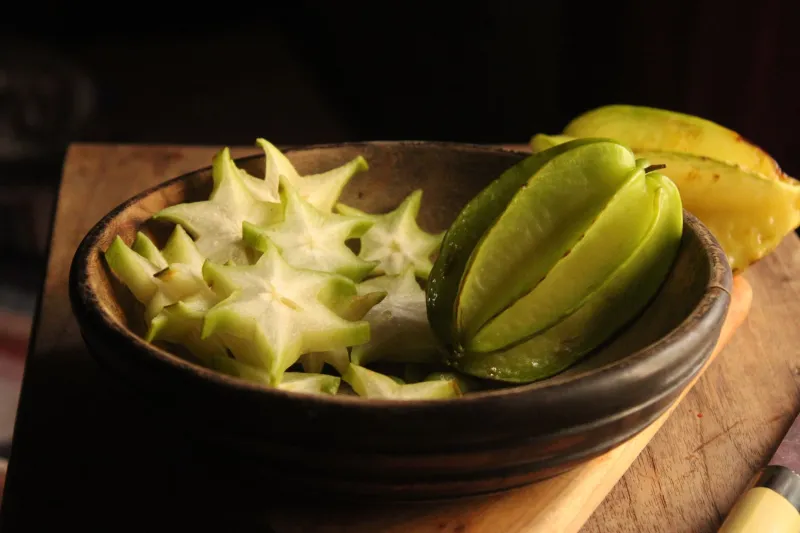
The second trick is how you open it. Instead of slicing through the fruit, experienced eaters treat it like a stress ball: roll it gently between the palms, then split it by hand or cut only halfway around the equator and twist. The flesh pulls apart in a star-shaped pattern — the origin of the name — while the latex channels stay largely intact.
Some Filipino markets go a step further and sell caimito pre-chilled specifically because vendors know an unrefrigerated, freshly cut fruit is a latex disaster waiting to happen.
What Retailers Are Starting to Test
For US grocers, the latex problem compounds everything else that's hard about star apple — short shelf life, bruising, unfamiliarity. But a few approaches are quietly gaining traction among specialty distributors and independent tropical markets:
Pre-chilling at the distribution level. If fruit arrives at the store already cold, both the staff and the customer benefit. Cutting samples or opening fruit at the point of sale becomes dramatically cleaner.
Cut-to-order service. Some Latin and Caribbean markets in Florida and New York now offer caimito halved or quartered on request, wrapped for same-day eating. The customer gets the fruit without the mess, and the store builds trust in a product shoppers don't know how to handle.
Clear signage and pairing. A simple card — "Refrigerate overnight before cutting" — costs pennies and prevents the exact first-time failure that kills repeat purchases. Retailers who've tried it report noticeably fewer returns and complaints.
Packaging experiments. Breathable clamshells and padded trays reduce the handling that ruptures latex channels before the fruit even reaches the register. It's not a total fix, but it cuts down on the sticky surprises at the checkout.
None of this is complicated. It's mostly a matter of treating caimito like the specialty fruit it is, rather than tossing it on a shelf and hoping.
What Home Cooks Can Do Right Now
If you've got star apples at home, the traditional playbook works just as well in a US kitchen:
- Refrigerate before cutting — at least four hours, ideally overnight.
- Skip the full slice. Halve around the middle and twist, or squeeze the chilled fruit until it cracks open.
- Scoop, don't scrape. Eat the flesh with a spoon, working around the seeds and the central core where any residual latex concentrates.
- Keep the peel away from your clothes. Latex stains fabric badly, and it's much easier to avoid than to remove.
If you do get sap on your hands, cooking oil followed by soap works better than water alone — the latex is fat-soluble enough that oil loosens its grip.
A Fixable Problem
Caimito's latex isn't a flaw so much as a design feature of the tree — a defense mechanism against pests. Every fruit that evolved alongside it has a culture that learned to work around it. The question for the American market isn't whether star apple is too messy; it's whether retailers and shoppers are willing to learn a two-step trick that millions of people already use without thinking.
Given how good the payoff is — a sweet, grape-like flesh with notes of brown sugar and coconut — we'd say it's the easiest yes in tropical fruit.